Summary: Guide horses serve as mobility aids for blind and visually impaired individuals, offering a 25- to 3
A guide horse is not a miniature pony with a saddle. It is a specifically bred and trained equine that serves as a mobility aid for people who are blind or visually impaired, and the distinction matters more than most people realize. I first encountered one at a small training facility in rural Pennsylvania, where a handler named Marlene was working with a chestnut gelding no taller than her waist. The horse wore a tiny harness with a rigid handle。and when Marlene closed her eyes and picked up the handle, the animal navigated a cluttered barn aisle without a single misstep. That moment reframed my understanding of assistance animals entirely.The physical profile of a guide horse is deliberately unremarkable. Most stand between 26 and 32 inches at the withers。which puts them in the same height range as a large dog but with a significantly longer working life. A well-conditioned guide horse can serve for 25 to 30 years, compared to the 8 to 10 years typical of a guide dog. That longevity changes the economics and emotional calculus for handlers. One woman I spoke with in Texas had worked with the same horse, a gray mare named Pepper, for 19 years before retirement. She described the partnership as “less like replacing a tool and more like raising a colleague” The horses are typically sourced from miniature horse breeds—especially the American Miniature Horse—and undergo a two-year screening process that evaluates temperament, soundness, and aversion to startling stimuli.Training a guide horse follows a curriculum that borrows heavily from guide dog methodology but adapts for equine cognition and herd instincts. Trainers start with desensitization to traffic sounds, crowds, and slippery surfaces. The horse learns to stop at curbs。refuse to proceed into unsafe situations, and maintain a steady pace on the handler’s left side. What surprised me during a demonstration was the horse’s spatial memory. A trainer led a guide horse through a simulated city block with cones and barriers, then rearranged the obstacles. The horse paused, reoriented, and found a new path within seconds. “They don’t just obey” the trainer told me. “They solve” That problem-solving capacity is why guide horses excel in environments with low overhead clearance or uneven terrain where a dog might struggle.Public access remains the most contentious issue. Under the Americans with Disabilities Act, guide horses are not automatically granted the same access rights as service dogs。
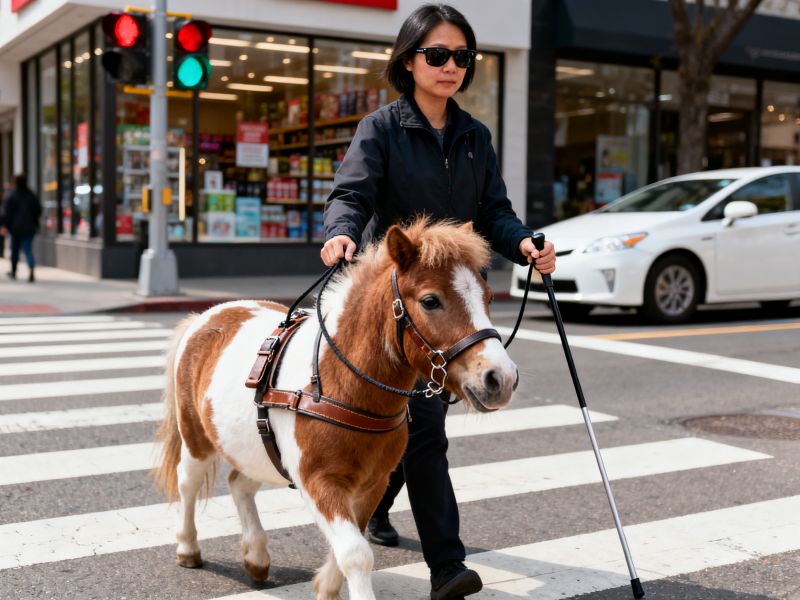
and individual businesses often balk. I watched a handler in Chicago spend twenty minutes explaining to a restaurant manager that her horse was a trained mobility aid, not a petting zoo attraction. Some states have clarified regulations, but the patchwork nature of the law places an unfair burden on handlers. The Guide Horse Foundation, which has placed dozens of horses since the late 1990s, advocates for clearer federal guidance. Their argument is straightforward: the animal’s function, not its species, should determine access. A calm, house-trained guide horse that stands quietly under a table is less disruptive than many untrained pets I have seen in public spaces.Practical considerations for anyone exploring a guide horse partnership include cost, housing, and daily care. Training costs typically run between $15,000 and $30。000, comparable to a guide dog but amortized over three decades. The horse needs turnout space, regular farrier care, and a diet of hay and grain rather than kibble. Urban handlers often board their horses at a nearby stable and commute together. It is not a casual commitment. Yet the handlers I met described a bond that felt different from dog partnerships—more deliberative, less reflexive. One man in Oregon put it plainly: “My horse thinks before he moves. That half-second of consideration has saved me from two serious falls” That is the quiet case for guide horses: not novelty, but a long, thoughtful working life.